Is Portaria Remota Worth It for a Small Condomínio?
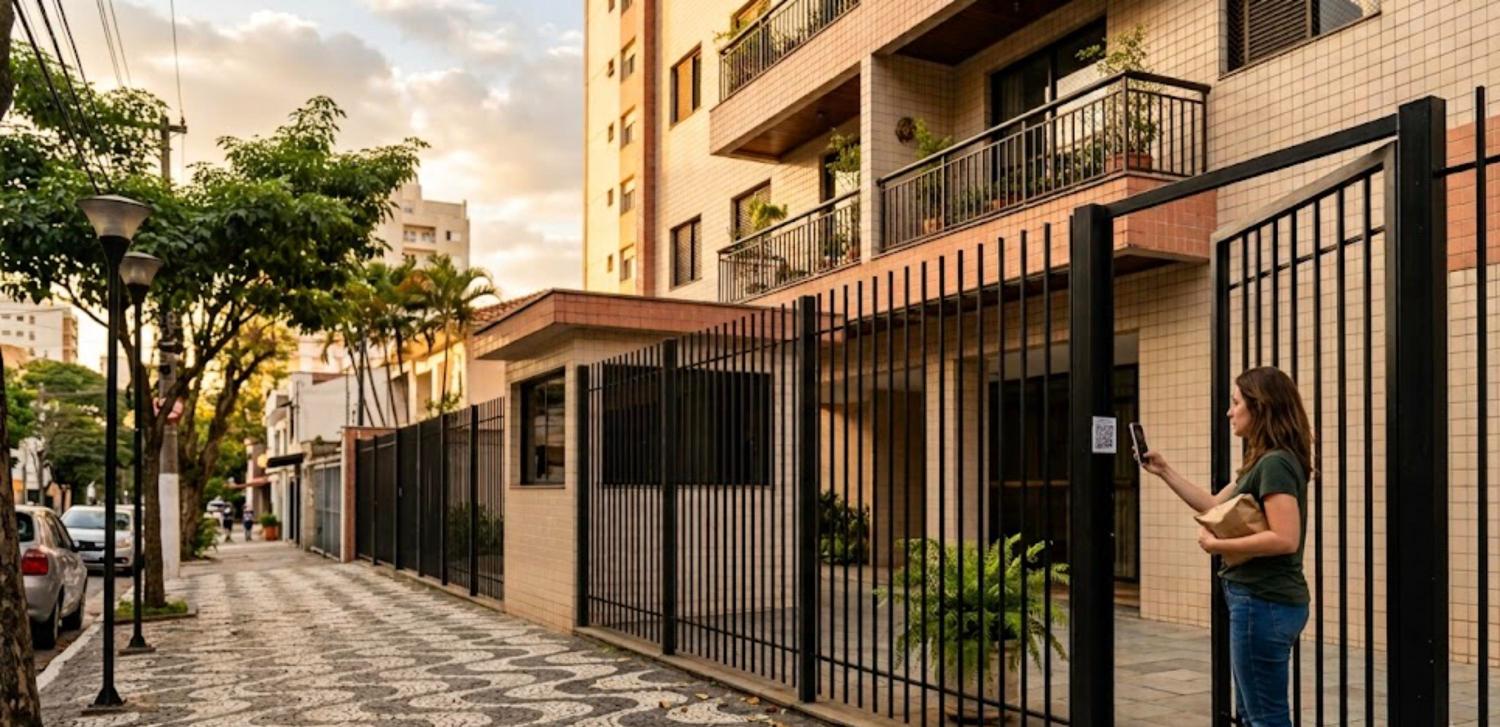
Quick Answer: Portaria remota is usually worth it when a condomínio is paying for a 24-hour on-site porteiro it can no longer afford. São Paulo estimates put a 24h post at R$23,500–25,000 a month, against about R$5,000 for remote service. Small buildings with phone-comfortable residents can go further with portaria autônoma: a QR video intercom that opens the gate they already have.
Key takeaways
- Staff is the biggest line in most condo budgets. A Secovi Rio survey found personnel was 56% of total condominium spending.
- Published 2026 São Paulo estimates: about R$23,500–25,000 a month for an outsourced 24h portaria, and from R$5,000 a month for portaria remota (up to 50 units).
- Portaria remota still puts a person in the loop (a remote operator). Portaria autônoma removes that layer: the visitor's call goes straight to the morador, who opens the gate.
- DoorVi, a QR-code video intercom and visitor management platform, is one way to run portaria autônoma. It uses a QR sticker or tablet at the entrance and a relay on the existing lock, so there is no new wiring to the apartments.
- You don't have to choose one model for the whole building. Many condomínios keep remote or on-site staff for the garage and night shift and go autonomous at the pedestrian door.
How portaria autônoma with a QR intercom works
- A DoorVi QR code (sticker or tablet) is placed at the pedestrian gate or lobby door.
- The visitor scans it with their phone camera. No app download is needed, and a building directory opens in the browser.
- The visitor picks the unit and starts a video call. It rings on the morador's DoorVi app.
- The morador sees and speaks to the visitor, then taps to open. A relay wired to the existing lock or gate motor (ESP32, Sonoff, Tasmota or Waveshare), or an integrated access-control system such as Intelbras, releases the door.
- The visit is logged with time, unit and who granted access.
Picture a common scene: it's 7:40 p.m., the courier is at the gate of a 32-unit building in Pinheiros, the porteiro's post was cut last year, and the old interfone in apartment 81 hasn't worked since the reform. Someone runs downstairs. That gap between "we cut the porteiro" and "we replaced what the porteiro did" is where most síndicos get stuck.
What is portaria remota?
Portaria remota is a service where an operator at a monitoring centre handles your building's entrance over cameras and an intercom, instead of a porteiro sitting in the guarita. The visitor presses the intercom, the call goes to the central, the operator identifies the visitor, checks with the resident and opens the gate remotely. Calls are recorded (Intersept).
It usually needs a hardware project: cameras, an IP intercom at the entrance, access control, and often an eclusa (two-door airlock) at the pedestrian entrance. You then pay a monthly fee to the provider.
What is portaria autônoma?
Portaria autônoma means residents authorise their own visitors, usually by video call on their phone, with no operator in between. Intersept describes it as the model where "the call reaches the resident's app" and the resident approves or denies with one click. It fits small-to-medium buildings with lower traffic and residents comfortable with smartphones (Intersept).
The problem: the porteiro line is the biggest cost in the budget
For most condomínios, staff costs are the single largest expense, which is why the portaria question comes up at almost every assembleia. A Secovi Rio survey found personnel represented 56% of total condominium spending (Sindiconet / Secovi Rio).
The wage floor keeps moving too. Under the São Paulo Sindifícios collective agreement for 2025/2026, the piso for a porteiro/vigia is R$2,096.09 a month, plus a R$17.90 daily meal voucher, a R$552.08 monthly food voucher and a health benefit, after a 6.05% adjustment (Sindiconet). That agreement runs to 30 September 2026, so budget for the next adjustment. A 24-hour post on a 12x36 schedule needs several porteiros, plus holidays, absences and payroll charges. That's why outsourced 24h portaria is quoted at R$23,500–25,000 a month in Greater São Paulo in 2026 (Empresas de Terceirização). Another national price table puts a 4-porteiro 12x36 post anywhere between R$10,000 and R$42,400 a month depending on the tier (oHub).
More people are exposed to this every year. IBGE's 2022 Census found 12.5% of Brazilians live in apartments, up from 8.5% in 2010 (IBGE Educa).
User journey: a 32-unit condomínio before and after going autonomous at the front door
Persona: Condomínio Edifício Jacarandá (hypothetical), 32 units, one pedestrian gate with an electric lock, one garage gate, an old analogue interfone system that half the apartments no longer use. The síndica, Renata, has been asked to cut the fee without making residents feel less safe.
The visitor or delivery rider
- Before: Presses the interfone button for apt 81. It doesn't ring because the handset upstairs is broken. They phone the resident, if they have the number, or wait for someone to come out.
- After: Scans the QR code at the gate with the phone camera, and a directory opens in the browser. They search "81", tap call, and a video call rings on the resident's phone. They never see the resident's phone number unless the resident has turned on "Callback Number".
- Expected guests don't even need the call. The resident sends a six-digit guest code or a pre-approval pass (single-use, date-range, recurring or event), and the visitor uses that at the entrance.
The morador (resident)
- Before: Answers the interfone only when home. Deliveries fail when they're out.
- After: Answers on their phone from anywhere: at work, in the lift, or travelling. They see the visitor on video and tap to open. Several household members can be linked to the same address (the number depends on the plan), so whoever is free can answer.
- Edge case, nobody answers: the visitor doesn't get in. That is the correct outcome for an unannounced visitor. For planned visits, use pre-approval passes so the guest doesn't depend on someone picking up.
The porteiro or zelador (if you keep one)
- Before: The porteiro is tied to the guarita, answering the interfone, calling apartments and writing names in a notebook.
- After: If the building keeps a porteiro for part of the day, DoorVi's Guard Doorman app lets them look up residents, call units and see the visitor log. In Guard+QR mode, visitors can self-serve via QR when the porteiro is busy. The porteiro can also call residents, and residents can call the porteiro, inside the app.
The síndica or administradora
- Day 1: Renata (or the installer) sets up the property in the admin dashboard at multi.doorvi.co, uploads residents by CSV, and chooses the entry mode: QR-only, Guard+QR, or Tablet+Reception. An electrician connects a relay to the existing pedestrian-gate lock and adds it in Relay Manager. A Waveshare ESP32 relay, for example, uses 2.4 GHz Wi-Fi and MQTT (DoorVi guide).
- Week 1: Residents install the app and link household members. The síndica sends a broadcast announcement explaining the new entrance and pins the pre-approval how-to.
- Month 1: The visitor log shows who came in, when, and who approved it. This is the record the assembleia will ask for. The síndica reviews it before deciding what to do with the night shift.
Before vs after in one line: before, entry depended on a person in the guarita or a working handset in each flat; after, entry depends on the resident's phone and a relay on the lock you already have.
Portaria presencial vs remota vs autônoma: side-by-side comparison
Short answer: remote portaria cuts payroll but keeps a paid operator. Autonomous portaria removes the operator and leaves the decision with the resident.
Approaches compared
| Approach | Visitor uses own phone | Entrance hardware | New wiring to units | Video calling | Visitor management | Lock / relay integration | Typical cost model |
|---|---|---|---|---|---|---|---|
| Porteiro presencial (24h) | No | Guarita + interfone | Existing interfone | No | Notebook or app | Porteiro presses the button | Monthly payroll or outsourced contract |
| Traditional analogue interfone | No | Panel + handsets | Yes (per unit) | No | None | Lock wired to the system | Hardware + maintenance |
| Portaria remota | No (uses the entrance intercom) | Cameras, IP intercom, often eclusa | Usually new cabling at the entrance | Operator side | Operator logs visits | Operator opens remotely | Setup project + monthly fee |
| App-based condo platform | Partly (pre-authorisations) | Varies; often readers or facial | Depends on hardware | Varies | Yes | Via integrated hardware | Subscription via integrator |
| QR video intercom (portaria autônoma) | Yes | QR sticker or tablet | None to the units | Yes, visitor to resident | Yes | Relay or access-control integration | Subscription; light hardware |
| DoorVi | Yes, scan with the phone camera, no app | QR sticker, optional tablet concierge | None | Yes | Guest codes, pre-approval passes, visitor log, Guard app | ESP32 / Sonoff / Tasmota / Waveshare relays; Intelbras, PDK, Brivo, Mobgate, igloohome integrations | Free and paid plans for homes; buildings quoted |
Named options in Brazil (public information, September 2026)
| Provider | What it is | How the visitor reaches the resident | Door opening | Price |
|---|---|---|---|---|
| Porter | Portaria remota operator | Entrance intercom to the monitoring centre | Operator opens remotely | Quote-based |
| uTech Portaria Mobile | Portaria autônoma with IP intercom at the entrance | Visitor enters the apartment number; the call rings the flat's interfone and the app at the same time | Resident releases via the app; QR and facial recognition for pre-authorised guests | Quote-based |
| Intelbras Allo | Wi-Fi video doorbells (w3, w5, w3+, w5+, wT7) | Visitor presses the device; the call goes to the Allo app | w3+ and w5+ open locks from the app; XR1 wireless relay | Retail hardware |
| Condomob | Condo platform with access control | Visitor QR codes and facial recognition | Integrates with Intelbras, Hikvision, Control ID and others via integrator partners | Monthly subscription via partners |
| uCondo | Condo management with a portaria module | Residents pre-authorise visitors in the app; porteiro app | Not stated on the page | Quote-based |
Where DoorVi fits best
- The visitor needs nothing but a phone. No app download and no panel at the gate. The QR code opens a directory in the browser.
- No wiring to the apartments. Calls go phone to phone, which is why it works in buildings where the old interfone cabling is dead (how a video intercom works without wiring).
- It opens the gate you already have. It uses a relay on the existing lock or motor (retrofit guide), or an integration with Intelbras, PDK, Brivo or Mobgate (integrations).
- It fits a mixed model. QR-only at night, Guard+QR when a porteiro is on duty, or a tablet concierge in the lobby (digital concierge).
- Planned visits skip the call. It supports six-digit guest codes and pre-approval passes.
- Residents' numbers stay private by default.
The layered model is already running elsewhere. A YashOne society in Pune, India has run MyGate at the main gate and DoorVi at the tower lobby for about a year, with no guard needed at that lobby door to let visitors in.
When another solution makes more sense
- Many elderly or less tech-comfortable residents: a human operator (portaria remota or presencial) will be a better experience. Intersept makes the same point.
- High traffic and strict service-provider protocols, such as large complexes with many contractors: a staffed or remote portaria handles the exceptions better.
- You want 24/7 human monitoring of cameras and alarms: that is what portaria remota sells. A QR intercom doesn't replace it.
- You want facial recognition or plate reading at the garage: look at access-control platforms such as Condomob or your Intelbras integrator. DoorVi can sit alongside them at the pedestrian door.
- A single house: a Wi-Fi video doorbell like Intelbras Allo, or DoorVi's single-home app, may be all you need.
Setup steps for a condomínio
- Map the entrances. List the pedestrian gate, lobby door and garage, and what lock or motor each one has.
- Choose the model per door. For example: pedestrian gate autonomous (QR), garage kept on tags, night shift remote.
- Fit the relay. An electrician connects an ESP32, Sonoff, Tasmota or Waveshare relay to the existing lock or motor input, or DoorVi connects to your Intelbras/PDK/Brivo system.
- Set up the property at multi.doorvi.co: upload residents by CSV, choose the entry mode, and add the relay in Relay Manager.
- Place the QR code (sticker or tablet) at the entrance at eye height, with good lighting.
- Onboard residents. Send a broadcast and a one-page guide, and show them how pre-approval passes work.
- Review the visitor log after 30 days before changing staff contracts.
On data: the LGPD applies to visitor records. The AABIC guide for condomínios says visitor data should be limited to what identification and security need, and that the condomínio must define when data is deleted (AABIC LGPD guide). Put that into your internal rules whichever model you choose.
Cost and ROI: a worked example
Assumptions (labelled): a 40-unit condomínio in Greater São Paulo. Prices are the published 2026 averages cited above and exclude setup. Your quotes will differ.
| Model | Monthly cost | Per unit per month | Per year |
|---|---|---|---|
| Outsourced 24h portaria | R$23,500–25,000 | R$588–625 | R$282,000–300,000 |
| Portaria remota (≤50 units) | from R$5,000 + setup project | from R$125 | from R$60,000 |
| Portaria autônoma (QR intercom + relay on the existing lock) | DoorVi subscription (quoted per property) + one relay per door + electrician visit | Ask for a quote | – |
How to read it: moving from a 24h post to portaria remota saves roughly R$18,500–20,000 a month on these numbers. Going autonomous at the front door is worth it when the quote for the QR intercom and relays comes in well under the ~R$125 per unit a month that remote service costs, and when your residents will use it. Because there is no new cabling, a pilot on one door is cheap to try before you cancel anything.
FAQ
Is portaria remota safe?
It can be. An operator verifies each visitor over camera and intercom, and calls are recorded. Safety depends on the entrance hardware (eclusa, locks, cameras) and the provider's protocols, so ask for both in the proposal.
What is the difference between portaria remota and portaria autônoma?
In portaria remota, an operator at a central handles the visitor. In portaria autônoma, the call goes straight to the resident, who opens the gate from their phone. Remota costs more because you pay for the operators.
How much does portaria remota cost in 2026?
Published São Paulo estimates start at about R$5,000 a month for condomínios up to 50 units and about R$6,500 for larger ones, plus a setup project. Prices depend on the number of entrances, the equipment and the hours covered.
Can we keep our Intelbras system and add a QR video intercom?
Yes. DoorVi lists Intelbras among its access-control integrations and can also drive a simple relay on the existing lock. You add the QR calling layer without ripping out what works.
What happens if the resident doesn't answer?
The unannounced visitor isn't let in, which is the safe default. For expected guests, residents send a six-digit code or a pre-approval pass in advance, so no live answer is needed.
Do visitors need to download an app?
No. With DoorVi the visitor scans the QR code with the phone camera and a directory opens in the browser. Only residents use the app.
Do we need new wiring to the apartments?
No. Calls go from the visitor's phone to the resident's phone over the internet. The only wiring is the relay connection to the existing lock or gate motor at the entrance.
Does LGPD apply to visitor logs?
Yes. Condomínios should collect only what identification and security need, tell visitors how their data is used, and set deletion rules. The AABIC LGPD guide for condomínios is a good starting point.
Related questions: How do delivery riders get into a condomínio when nobody's home? · Can a condomínio replace a broken interfone without rewiring every apartment? · Portaria remota at night only: does a hybrid model work? · How do I open the condomínio gate from my phone? · What should a portaria remota contract include?
About the author: Sachin Gupta is Director of DoorVi. He works on QR video intercom and relay-based door-opening deployments for apartment buildings and condomínios in Brazil, India, the US and the UAE.
By Sachin Gupta, Director, DoorVi. Last updated: 27 September 2026.
Try it on one door first
If your condomínio is weighing portaria remota, price the third option before you sign. Book a 15-minute DoorVi demo and we'll map your entrances and locks with you. Portuguese speakers can start at doorvi.co/pt.
Book a 15-minute demo