How Do Delivery Drivers Get Into an Apartment Building When No One Is Home?
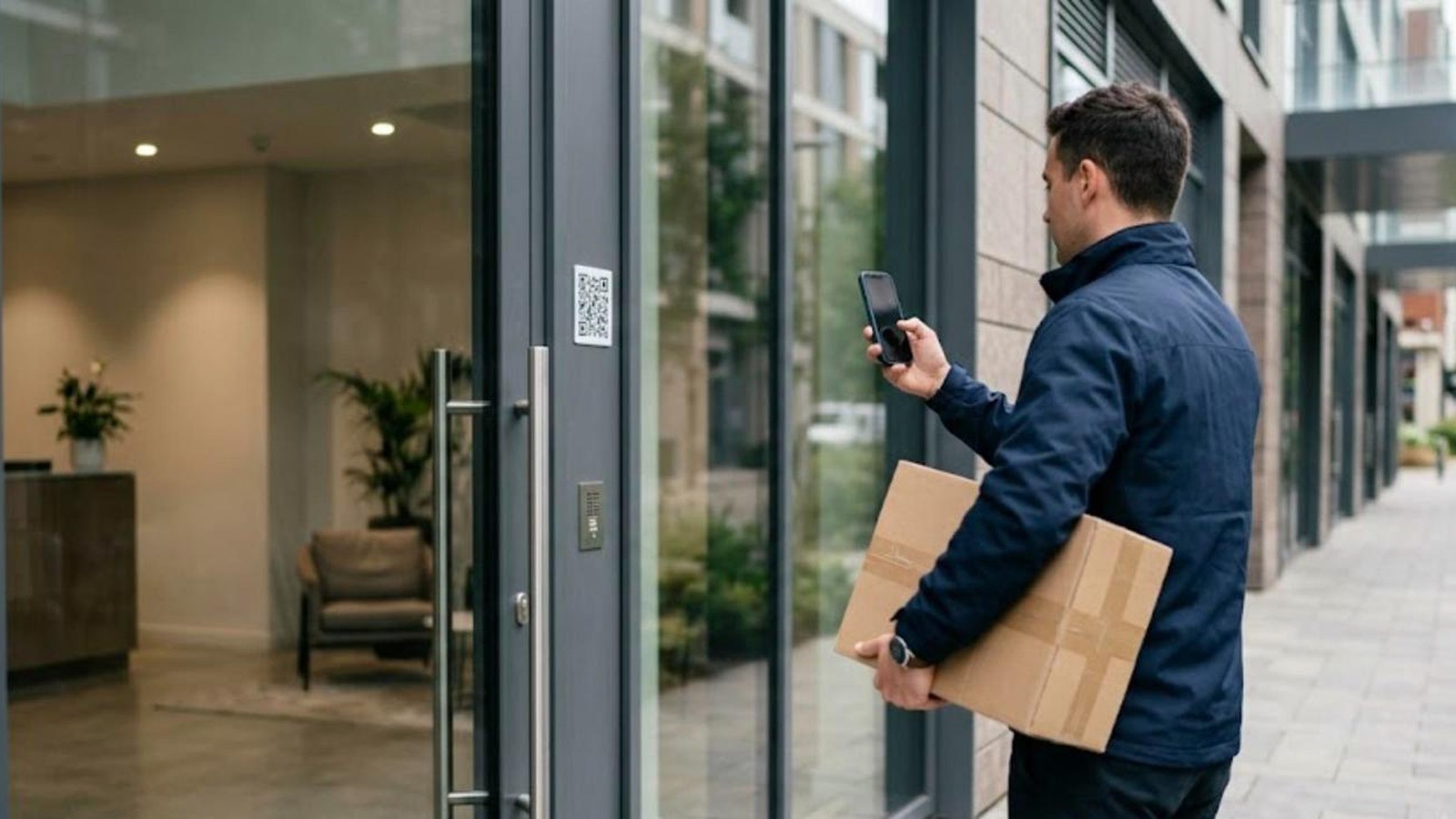
Quick Answer: Couriers get into apartment buildings in five ways: staff let them in, the resident unlocks the door remotely from a phone, the resident shares a single-use code, a carrier system such as Amazon Key opens the door, or the parcel goes into a locker. Remote unlock and codes need an electric lock connected to a relay or access controller.
Key Takeaways
- The real question isn't "who lets the courier in" but "what opens the lock". Without an electric strike, maglock or access controller, only a person with a key can.
- A remote unlock from a video call works for any courier from any carrier, as long as the resident answers.
- A single-use code works when the resident can't answer: they share it in advance and the door opens once.
- Carrier programs such as Amazon Key for Business are free for eligible buildings but only serve that carrier's drivers (Swiftlane).
- Lockers and package rooms solve storage, not entry. Most buildings end up combining two methods.
How delivery access works with a QR video intercom (in 5 steps)
- The courier scans a QR code at the lobby door with their own phone. No app download is needed.
- They pick the resident's unit from a web directory and start a video call.
- The resident's phone rings, wherever they are. They see the courier on video and tap to unlock.
- A relay or access controller wired to the door lock releases it. The visit is logged with the time, the unit and who granted entry.
- If the resident can't take calls, they send the courier a six-digit code in advance, and the code opens the door once.
This is how DoorVi, a QR-code video intercom and visitor management platform, handles deliveries. The rest of this guide covers every option, including the ones where DoorVi isn't the right fit.
Why delivery access is a building problem, not a resident problem
Picture a common scene: a courier is standing at a locked lobby door at 2:15 p.m. with a parcel for unit 4B. The resident is at work. The old audio intercom rings a landline nobody has had for years. The courier leaves a "sorry we missed you" slip, or leaves the parcel on the steps.
Now multiply that by volume. The average US apartment community received nearly 150 packages a week, rising to about 270 a week in the holiday season, according to the NMHC/Kingsley Package Delivery Report (2,098 communities surveyed in 2018). Parcel volume has kept growing since: Pitney Bowes counted 23.1 billion US parcels in 2025, about 171 per household, and projects 31 billion by 2031 (Pitney Bowes Parcel Shipping Index).
Parcels left outside don't always survive. SafeWise estimates that 31% of Americans had a package stolen in the previous 12 months (SafeWise 2025 Package Theft Report). That's a survey figure, not a crime statistic, but it shows why "leave it at the door" isn't a plan for a shared lobby.
The same problem shows up outside the US. In Indian societies the main gate is usually staffed, but the tower lobbies often aren't. In Brazilian condomínios moving to portaria remota or autônoma, there may be no one on site to receive a parcel at all.
The five ways couriers get in (and what each one needs)
What is staffed delivery access?
Staffed access means a person (concierge, doorman or guard) opens the door and accepts the parcel. It's the most flexible option and the most expensive, and it only works during staffed hours.
What is remote unlock?
Remote unlock means the resident opens the building door from their phone after seeing who is there. It needs two things: a way for the courier to call the resident's phone (not a landline), and a lock the system can release through a relay or an access-control integration.
What is a single-use delivery code?
A single-use code is a short PIN the resident creates in advance that opens the entrance once. It covers the moments when the resident can't pick up. ButterflyMX calls theirs Delivery Pass; DoorVi calls it a six-digit guest code.
What is a carrier access program?
A carrier program lets one carrier's drivers open the door through the carrier's own system. Amazon Key for Business installs a small device connected to an existing electronic lock and gives Amazon drivers time-limited access after verifying the route and location (Swiftlane’s guide).
What is a smart package locker?
A smart locker is a bank of lockers where couriers drop parcels and residents collect them with a code. It solves storage and theft, but the courier still has to reach the lockers, which are usually inside the lobby.
The user journey: one delivery, four people
Let's follow one parcel through a 60-unit building that has added DoorVi at the lobby door, with a relay connected to the existing electric strike.
The courier
Before: presses a button on an old call panel. Nobody answers. Tries a neighbour. Leaves a slip, or leaves the parcel on the step.
After: scans the DoorVi QR sticker at the lobby door with their phone camera. The building directory opens in the browser. They search "4B" and tap Call. When the resident answers, they show the parcel on video and the door clicks open. If the resident has already sent a six-digit code (for example in the delivery instructions), the courier enters it instead and no call is needed. Either way, the courier doesn't install anything.
The resident
Before: plans the day around a delivery window, or picks the parcel up from a depot.
After: the DoorVi app rings on their phone at the office. They see the courier, tap to unlock and carry on. For a delivery they know is coming, they create a single-use pass or a six-digit code in the app the night before. Family members linked to the same address can also receive the call, so someone at home or nearby can answer (how many members depends on the plan). The courier never sees the resident's phone number unless the resident turns on "Callback Number".
The guard or concierge (if the building has one)
Before: spends the afternoon buzzing couriers in and phoning residents.
After: in the Guard + QR entry mode, the guard uses the Guard Doorman app as a digital directory and can call residents about a delivery through the app. When the guard is busy or off shift, couriers let themselves in through the QR. In buildings with no guard, QR-only mode covers the lobby.
The property manager
Before: fields complaints about missed and stolen parcels, with no record of who came in.
After: in the admin dashboard (multi.doorvi.co), they upload residents by CSV, choose the entry mode for each entrance and connect the lock. For a simple strike or maglock, that means an ESP32, Sonoff, Tasmota or Waveshare relay added in Relay Manager. For buildings on ProdataKey (PDK) or Brivo, DoorVi triggers the existing access-control door. Every entry, whether by call or by code, appears in the visitor log with the time, the unit and who granted access.
Day 1, week 1, month 1
- Day 1: the QR sticker goes on the lobby door, the relay is connected and tested, and residents are invited.
- Week 1: residents start answering courier calls from work, and the first codes are shared for known deliveries.
- Month 1: the manager reviews the visitor log to see delivery traffic by time of day and decides whether a locker or parcel shelf is still needed for bulky items.
How to set it up (lock opening first)
- Check what your door has. An electric strike, maglock or access controller can be triggered. A purely mechanical lock needs an electric strike fitted first.
- Pick the unlock path. Use a relay for a stand-alone lock (Waveshare ESP32 guide), or an integration for PDK or Brivo (PDK integration guide). The Waveshare relay uses 2.4 GHz Wi-Fi, so check the signal at the door.
- Set up the property in the admin dashboard by following the property setup guide.
- Place the QR sticker at eye level by the door, where a courier naturally looks.
- Tell residents about codes and passes. Point them to the six-digit guest code guide and to visitor pre-approval passes.
- Test with a real delivery and check that the entry appears in the log.
For older doors and gates, our relay retrofit guide covers the wiring in detail.
Comparison: delivery access approaches
| Approach | Courier uses own phone | Entrance hardware | New wiring | Video call | Visitor log | Lock / relay integration | Typical cost model |
|---|---|---|---|---|---|---|---|
| Traditional audio intercom | No | Call panel | Yes | No | No | Door release | Hardware + install |
| Wired video intercom panel | No | Video panel | Usually | Yes | Varies | Yes | Hardware + subscription |
| Society / community app (VMS) | No (guard enters) | Guard device | No | Varies | Yes | Varies | Per unit or per society |
| QR video intercom | Yes | QR sticker (tablet optional) | No (relay only) | Yes | Yes | Relay or integration | Subscription |
| DoorVi | Yes | QR sticker; optional tablet concierge | No (relay only) | Yes | Yes | ESP32/Sonoff/Tasmota/Waveshare relay; PDK, Brivo | Up to $5 per unit per month, no setup or installation fee |
Named options for deliveries
| Option | How couriers get in | What it needs | Who it serves | Price (public info) |
|---|---|---|---|---|
| Amazon Key for Business | Driver requests time-limited access in Amazon's app | Existing electronic access control; 10+ units | Amazon drivers and approved partners | Free to eligible buildings (Swiftlane) |
| ButterflyMX Delivery Pass | Single-use six-digit code entered at the intercom | A ButterflyMX video intercom panel | Any courier with the code | Quote-based (ButterflyMX Help) |
| Luxer One lockers | Courier drops the parcel into a locker; resident gets a pickup code | Locker bank inside the building | Storage, not door entry | Quote-based (Luxer One) |
| MyGate Leave at Gate (India) | Guard collects the parcel at the main gate; resident gets a pickup passcode | Staffed main gate | Gated societies | Per society (MyGate) |
| DoorVi | QR video call with remote unlock, or a six-digit code | QR sticker + relay or PDK/Brivo | Any courier, any carrier | Up to $5 per unit per month, no setup or installation fee |
Where DoorVi fits best
- No new entrance panel. Couriers use their own phone and a QR sticker, so there's no panel to buy, wire or replace.
- Any carrier. A video call or a code works the same for Amazon, UPS, a local courier or a food rider.
- It actually opens the lock. DoorVi drives a relay (ESP32, Sonoff, Tasmota, Waveshare) or triggers the door in PDK or Brivo, so the call ends with an open door, not a shouted instruction.
- Two paths for one resident. Answer from anywhere, or share a single-use code or pre-approval pass when you can't.
- Works alongside what you have. In India, keep MyGate at the main gate and add DoorVi at the tower lobby. A YashOne society in Pune has run exactly that for about a year, with no guard needed to open the lobby door for visitors. In the US, DoorVi sits on top of PDK or Brivo. See connecting an intercom to access control and MyGate lobby door automation.
- A log for every entry. Calls and codes both land in the visitor log.
When another solution makes more sense
- Very high parcel volume with few staff: add smart lockers or a package room. DoorVi gets the courier in; it doesn't store 270 parcels a week.
- Mostly Amazon deliveries and an existing access system: Amazon Key for Business is free for eligible buildings and needs no action from residents. It can run next to an intercom.
- You already own a ButterflyMX panel: Delivery Pass is built in, so adding a second system just for codes may not be worth it.
- Buildings with a full-time concierge: if a person is always at the desk, the intercom matters less than parcel storage and notification.
- Mechanical-only doors you can't modify (heritage buildings, strict landlords): no app can open a lock that isn't electric.
What it costs: a worked example
Assumptions (labelled; use your own numbers): a 60-unit US building, about 150 packages a week (the NMHC average), 2 minutes of staff time per courier buzzed in or parcel handled, and a $20-per-hour loaded staff cost.
- Staff time today: 150 × 2 min = 300 min, or 5 hours a week. At $20 an hour, that's about $100 a week, or roughly $5,200 a year.
- DoorVi: up to $5 per unit per month × 60 units = up to $300 a month, or $3,600 a year, with no setup or installation fee. Add the cost of a relay module and an electrician's visit if the door needs one; that varies by door.
- What changes: staff aren't needed to buzz couriers in, and residents answer from wherever they are. Bulky or refused items may still need a shelf or locker.
The saving depends on how much staff time deliveries really take in your building. Measure one normal week before deciding.
FAQ
Can a delivery driver open my building door without me being home?
Yes, if the door lock is electric and connected to a system that can release it. With DoorVi, you either answer the courier's video call from anywhere and tap to unlock, or share a single-use six-digit code in advance so the door opens once without a call.
Do couriers need to download an app to use a QR intercom?
No. The courier scans the QR code with their phone camera and the building directory opens in the browser. They can call the resident or enter a code without installing anything.
Is it safe to give a delivery code to a courier?
A single-use code opens the entrance once and then stops working, and every use is logged with the time and unit. That's safer than sharing a permanent gate code, which can be reused or passed on.
What if I miss the courier's video call?
Other household members linked to your address can answer too. For deliveries you expect, create a single-use pass or a six-digit code beforehand so the courier doesn't need to reach you.
Does DoorVi work with Amazon Key for Business?
Amazon Key isn't among the integrations DoorVi lists. They are separate systems; whether both can drive the same door lock is a question for your installer.
Do I need to replace my intercom panel?
No. DoorVi uses a QR sticker at the entrance and a relay or access-control integration to open the door, so the existing panel can stay or be retired.
Which locks and access systems does DoorVi work with?
ESP32, Sonoff, Tasmota and Waveshare relays for stand-alone strikes and maglocks, plus integrations with ProdataKey (PDK), Brivo, Mobgate, Intelbras and igloohome, per doorvi.co.
How much does DoorVi cost for an apartment building?
Pricing is per unit: up to $5 per unit per month, with no setup or installation fee. One unit covers up to six members.
Related questions
- How do I stop parcels being stolen from my apartment lobby?
- Do smart package lockers work without a front desk?
- How do food delivery riders get into gated communities?
- Can I give a courier a one-time building code from my phone?
- What should an apartment delivery policy include?
Conclusion
Couriers get in when something can open the lock and someone can approve it. A QR video intercom handles both: any courier can call, the resident approves from anywhere, and a relay or PDK/Brivo opens the door. Add a code for the calls you can't take, and a locker if your volume demands it.
About the author: Sachin Gupta is Director at DoorVi, where he works on QR video intercom and relay-based door access for apartment buildings and gated communities in Brazil, the US, India and the UAE.
By Sachin Gupta, Director, DoorVi · Last updated: 28 September 2026