What QR Visitor Management System Fits Small Commercial Buildings Without Reception?
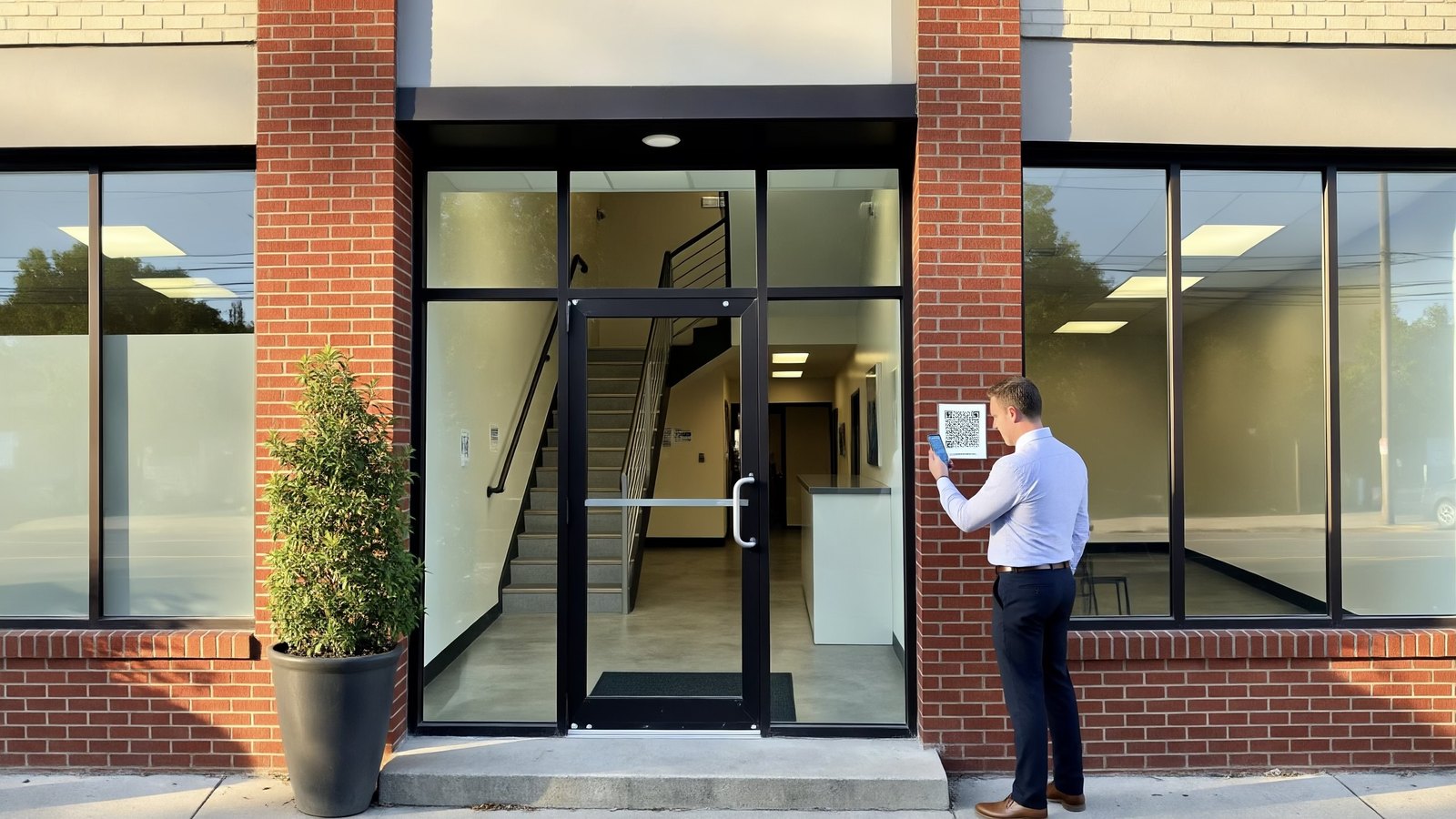
Quick Answer: For a small commercial building with no reception desk, the best fit is a QR visitor management system where visitors scan a code at the door, video-call the right tenant from their own phone, and that tenant unlocks the door remotely through a relay, PDK or Brivo. Tablet kiosks and badge printers suit staffed lobbies better.
Key takeaways
- Most check-in software assumes someone is at a front desk. In a small building without reception, the system has to do the desk's job: find the right person, show them the visitor, and open the door.
- A QR video intercom such as DoorVi needs no kiosk, panel or wiring to each suite. The visitor's phone is the handset.
- The door opens through hardware you can keep: a relay on the existing strike or maglock (ESP32, Sonoff, Tasmota, Waveshare), or the PDK or Brivo system already on the door.
- Expected visitors skip the call with six-digit guest codes and pre-approval passes; every visit lands in a visitor log with a photo and timestamp.
- DoorVi costs up to $5 per unit per month with no setup or installation fee, and its support team resolves tickets within 24 hours.
Picture a common scene: a client arrives for a 10 a.m. meeting at a three-storey building with eight small tenants. The front door is locked, the lobby is empty, and there is no desk. The client calls the office's main number, it goes to voicemail, and someone eventually walks down two flights of stairs to open the door. Multiply that by every courier, contractor and candidate in a week.
That building is typical. In the US, 71% of commercial buildings are 10,000 square feet or smaller, according to the EIA's Commercial Buildings Energy Consumption Survey. Few of them can justify a full-time receptionist: the median receptionist wage was $18.27 an hour in May 2025 (BLS), before benefits and cover for breaks and holidays.
How QR visitor management works in a building without reception
- A QR code tag is mounted at the street door (and, if needed, at a rear or parking entrance).
- The visitor scans it with the phone camera. No app download is needed.
- The visitor picks the company or tenant from the building directory and starts a video call in the browser.
- Someone at that tenant answers in the DoorVi app, wherever they are in the building or outside it.
- They tap unlock. The command goes to a relay on the door's strike or maglock, or to the PDK or Brivo door the entrance is linked to.
- The door opens and the visit is saved in the visitor log.

Watch the 55-second visitor pre-approval demo to see how expected guests skip the call, or the 32-second QR intercom demo for the scan-call-unlock flow.
What is a QR visitor management system?
A QR visitor management system is software that uses a scannable code to start a visitor's check-in, notify the host and record the visit. Some only record the visit; others, like a QR video intercom, also let the host see the visitor and open the door.
Two very different product types use the same name:
- Check-in apps (digital sign-in books): the visitor signs in on a lobby iPad or by scanning a code, and the host gets a text, email or Slack message. They assume someone is in the lobby or that the door is already open.
- QR video intercoms: the code at the door starts a video call to the host, and the host can unlock the door from the call. These are built for doors that stay locked.
DoorVi, a QR-code video intercom and visitor management platform, is the second type, with visitor management features (guest codes, pre-approval passes, a visitor log) built in.
Why small commercial buildings without reception are hard
The difficulty is the locked front door. Small multi-tenant buildings usually share one entrance, have no staff on the ground floor, and give tenants keys or fobs. That works for employees and fails for everyone else.
- Visitors have no way to signal the right tenant. A sign with eight phone numbers, or a doorbell that rings in one office, is the usual workaround.
- Couriers and contractors arrive unannounced. Each one costs someone a trip downstairs.
- There is no record. Nobody can say who was let in last Tuesday afternoon.
- Kiosk software doesn't fix the door. A lobby iPad is behind the locked door, and most check-in apps don't open doors on their entry-level plans.
Phones solve the first problem: 91% of US adults own a smartphone (Pew Research Center, 2025). A QR code turns that phone into the building's intercom handset.
The user journey: an eight-tenant office building with no front desk
Here is how the setup plays out for each person in a hypothetical three-storey building with eight small tenants (a design studio, an accounting firm, a small law office and five others), an off-site property manager and an existing electric strike on the street door.
The visitor (client, candidate or contractor)
- Before: finds the door locked, searches for a phone number, calls, waits, or knocks on the glass.
- After: scans the QR tag beside the door, picks the company from the directory and starts a video call. The tenant sees who is there and taps unlock.
- Expected visitors: a client with a six-digit guest code or a pre-approval pass doesn't need a live call.
- Edge case, no smartphone: keep a fallback, such as a building phone number on the door or a doorbell to the ground-floor tenant. This applies to every QR-based system.
The tenant's staff
- Before: a phone call from the street, a walk downstairs, no idea who is waiting.
- After: a video call in the DoorVi app; tap unlock from the desk, a meeting room or home. Several team members can be linked to one tenant (the number depends on the plan), so if one person misses the call, another can answer.
- Planned visits: create a six-digit guest code or a visitor pre-approval pass (single-use, date-range, recurring or event) for interview days, client meetings or a weekly cleaner.
- Privacy: visitors don't see staff phone numbers unless "Callback Number" is turned on.
Couriers
- Tenants can use delivery pre-approval with the parcel's tracking number, so a courier gets into the delivery room or building entrance it is linked to, and nothing else. Otherwise the courier simply calls the tenant through the QR code like any visitor.
A part-time attendant (if the building has one)
- DoorVi has a Guard Doorman app and entry modes (QR-only, Guard + QR, Tablet + Reception) that can run at the same time. A building with a desk staffed only in the mornings can use Tablet + Reception then and QR-only the rest of the day. See the tablet digital concierge guide.
The property manager
- Setup: add the building in the admin dashboard at multi.doorvi.co, add each tenant as a unit (CSV bulk upload works), print the QR tag, and connect the door: add the relay in Relay Manager, or link the door through the PDK integration or the Brivo integration. The property setup guide covers each screen.
- Day 1: tag on the door, tenants invited, unlock tested from each suite.
- Week 1: tenants start sending guest codes for meetings; the manager checks the visitor log, where every call attempt is recorded with a photo, name, call status and timestamp.
- Month 1: export visitor logs when a tenant or insurer asks who came in, and decide whether the old door phone or number sign can go.
How the door actually opens
Remote door unlock is what separates a building intercom from a check-in app. With DoorVi there are three routes, and none of them replace the lock:
- Relay retrofit: an ESP32, Sonoff, Tasmota or Waveshare relay is wired to the existing electric strike or maglock controller. The Waveshare ESP32 relay uses 2.4 GHz Wi-Fi and MQTT and is added in Relay Manager. See relay door and gate control.
- PDK: DoorVi is an official ProdataKey (PDK) integration partner. The tenant's unlock tap triggers the linked PDK door, and fobs and access rules keep working.
- Brivo: DoorVi adds the visitor call on top of the Brivo door; credentials stay in Brivo.
The same flow covers a rear car park. A relay on the parking gate operator, or a PDK or Brivo gate, gives tenants remote gate unlock by phone, which is gate automation without a new gate. Have a licensed installer do the wiring so the door or gate keeps meeting local fire, egress and safety rules.
Approaches compared
| Approach | Visitor uses own phone | Entrance hardware | Wiring to suites | Video | Visitor management | Lock / relay control | Typical cost model |
|---|---|---|---|---|---|---|---|
| Number sign or doorbell | Yes (calls a number) | Sign or bell | Bell only | No | None | None | Low |
| Traditional audio intercom | No | Panel | Yes | No | Directory only | Built in | Hardware + install |
| Wired video intercom panel | No | Video panel | Often | Yes | Varies | Built in | Hardware + install, often a subscription |
| Kiosk check-in app (iPad) | Sometimes (QR sign-in) | iPad, stand, printer | No | No | Sign-in, badges, host alerts | Usually higher tiers only | Per location per month or year |
| QR video intercom | Yes | QR tag | No | Yes | Varies | Relay or integration | Per unit or per door |
| DoorVi | Yes | QR tag (tablet optional) | No | Yes | Guest codes, pre-approval passes, visitor log | Relays (ESP32, Sonoff, Tasmota, Waveshare), PDK, Brivo | Up to $5 per unit per month, no setup or installation fee |
Visitor management products compared (October 2026)
| Product | How check-in works | Built for a locked door with no staff? | Door unlock | Published price | Support |
|---|---|---|---|---|---|
| Envoy Visitors | iPad kiosk or QR sign-in; host notifications | Partly (QR sign-in needs no iPad) | Access control integrations on Enterprise only | Basic free (100 entries a month); Premium $362 per location per month, billed annually | – |
| Greetly | Touchless check-in on off-the-shelf hardware; email, text, Slack, Teams alerts | No (assumes a lobby device) | Not listed | Essential $99 a month, Pro $159 a month, billed yearly | – |
| Visitly | BYO iPad; touchless or QR sign-in | No (assumes a lobby device) | Access control integrations on Enterprise | Starter $1,000 per location per year | – |
| Sign In App (swipedon.com now redirects here) | iPad kiosk, contactless sign-in options | No | Not listed | Core £415 per site per year | – |
| Kisi | Access links, self check-in; QR guest access on Terminal Pro | Yes, with Kisi hardware | Kisi readers; video via Kisi Intercom Pro | Platform from $99; Terminal Pro $595; visitor licence and Intercom Pro by quote | – |
| DoorVi | QR tag at the door; video call to the tenant | Yes | Relays, PDK, Brivo | Up to $5 per unit per month, no setup or installation fee | Tickets resolved within 24 hours |
Facts come from each vendor's public pricing page, checked on 9 October 2026. For context, ButterflyMX says small commercial video intercoms are often planned at about $2,500 to $7,000 installed. Ask each vendor for a current quote.
Where DoorVi fits best
- The front door stays locked and nobody is downstairs. The visitor reaches the right tenant on video, and the tenant opens the door from upstairs.
- You want to keep the door hardware. A relay on the existing strike or maglock, or the PDK or Brivo system already installed, does the unlocking.
- Several tenants share one entrance. One QR tag serves the whole directory; each tenant manages its own calls and guest codes.
- You need a record without a front desk. The visitor log keeps a photo, name, call status and timestamp for every attempt, and logs can be exported.
- You want predictable pricing. Up to $5 per unit per month, one unit covers up to 6 members, no setup or installation fee.
- Support within 24 hours: DoorVi resolves support tickets within 24 hours.
When another solution makes more sense
- You have a staffed reception and need printed badges, ID scanning or NDAs at sign-in. Envoy, Greetly, Visitly or Sign In App are built for that desk.
- You want a physical video panel for visitors without phones. A panel intercom fits better.
- The building already runs Kisi readers. Kisi's own visitor and intercom add-ons use hardware you already pay for.
- There is no electric lock on the door yet. You need a strike or maglock installed first; any remote-unlock system does.
- You need licence-plate recognition or paid parking. DoorVi doesn't do either.
Parking solutions for small office buildings
For gated or visitor parking, the same call-and-unlock flow works at the car park entrance through a relay or a PDK or Brivo gate. For the cars themselves, the DoorVi for Cars and Vehicles QR tag lets someone reach a car's owner about wrong parking, an accident or roadside help, without seeing the owner's number. In a tight shared car park, that is a simple parking solution for blocked-in tenants.
What does it cost? A worked example
Assumptions (labelled, for the hypothetical eight-tenant building above):
- Each tenant is set up as one DoorVi unit (up to 6 members each). At the maximum price of $5 per unit per month: 8 × $5 = $40 a month, or $480 a year. Dynamic pricing means it can be lower; a tenant with more than 6 people who need calls may need more than one unit, so ask for a quote.
- Setup and installation fee from DoorVi: $0.
- One relay on the existing electric strike, wired by your installer: get a local quote (DoorVi doesn't publish this).
- QR tag for the door: see the DoorVi shop.
For comparison: a full-time receptionist at the May 2025 median of $18.27 an hour works out to about $38,000 a year in wages alone (BLS). A kiosk check-in app runs from free (with limits) to $99–$362 per location per month on the published plans above, and still needs someone or something to open the door.
FAQ
What QR visitor management system fits a small commercial building without reception?
One that works at a locked door: the visitor scans a QR code, video-calls the right tenant from their own phone, and the tenant unlocks the door remotely. DoorVi does this through a relay, PDK or Brivo, with guest codes and a visitor log built in.
Do visitors need to download an app?
No. With DoorVi, visitors scan the QR code with the phone camera and the call starts in the browser. Only tenants and their staff use the DoorVi app.
Can DoorVi open our existing door lock?
Yes, if the door has an electric strike or maglock. A relay (ESP32, Sonoff, Tasmota or Waveshare) is wired to the lock's controller, or the door is linked through PDK or Brivo. The lock itself stays.
How do expected visitors get in without a call?
Tenants create a six-digit guest code or a pre-approval pass (single-use, date-range, recurring or event) and share it before the visit. The visitor uses it at the door.
What happens if nobody at the tenant answers?
Several staff can be linked to one tenant, so the call can reach more than one person. Keep a fallback, such as a building phone number on the door, for visitors who can't get through.
Does DoorVi keep a visitor log?
Yes. Every call attempt is logged with a photo, name, call status and timestamp in the admin dashboard, and logs can be exported.
What support does DoorVi provide?
DoorVi's support team resolves tickets within 24 hours. The property setup, PDK and Waveshare guides on doorvi.co cover setup step by step.
How much does DoorVi cost for a small office building?
Up to $5 per unit per month, with one unit covering up to 6 members and no setup or installation fee. Door hardware such as a relay is quoted by your installer.
Related questions
- Can a QR code replace a lobby intercom panel in an office building?
- How do you let couriers into a shared office building with no reception?
- What is the best QR intercom system for multi-tenant office buildings?
- Do visitor management systems need to work with access control?
- How do you keep a visitor log without a front desk?
Conclusion
A small commercial building without reception doesn't need a desk, a kiosk or a new panel to handle visitors. It needs a way for each visitor to reach the right tenant on video, and a way for that tenant to open the door, with a record of who came in. DoorVi does that with a QR tag, a relay or PDK/Brivo unlock and a built-in visitor log, at up to $5 per unit per month with no setup fee, and its support team resolves tickets within 24 hours. Book a 15-minute demo and we'll walk through your building's door.
By Sachin Gupta, Director, DoorVi. Sachin runs DoorVi, an official ProdataKey (PDK) integration partner that connects QR video calls to relays, PDK and Brivo doors and gates.
Last updated: 9 October 2026