How Do You Manage Visitors in a Small Building With No Security Guard in India?
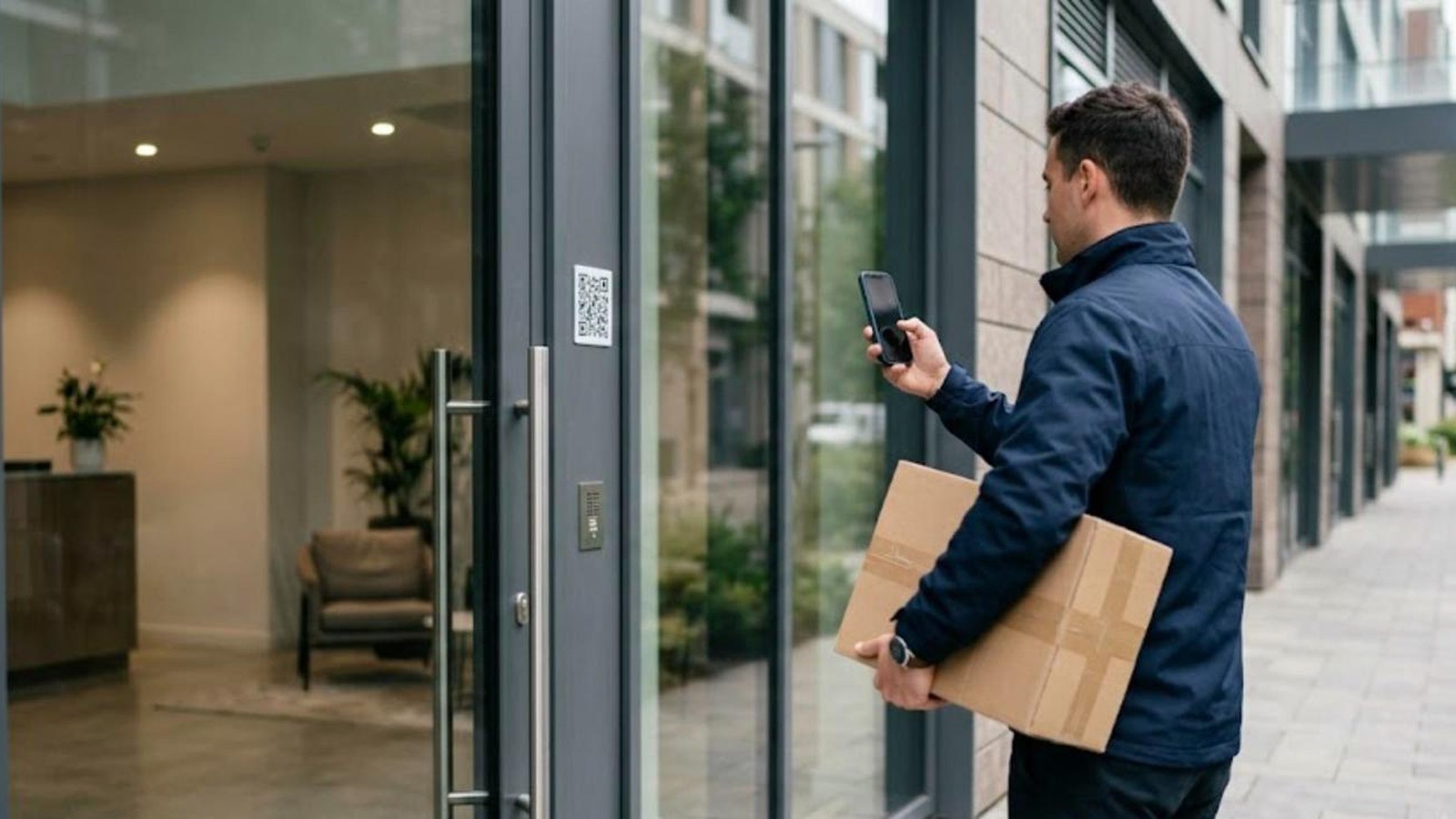
Quick Answer: Visitor management without a security guard works when every visitor can reach the right flat directly and residents can verify and let them in remotely. A QR-code video intercom such as DoorVi does this: the visitor scans a QR at the gate, video-calls the resident from their own phone, and the resident unlocks remotely, with every visit logged.
Key takeaways
- Society apps like MyGate, NoBrokerHood and ADDA GateKeeper are built around a guard at the main gate. DoorVi covers the doors where no guard is posted, like small-building gates and tower lobbies, and it can run alongside MyGate.
- DoorVi, a QR-code video intercom and visitor management platform, lets visitors call residents from their own phone with no app download and no intercom wiring.
- Expected visitors (deliveries, maids, plumbers) can use pre-approved passes or a six-digit guest code, so nobody has to run down to the gate.
- A 24x7 guard at Delhi's unskilled minimum wage costs over ₹55,000 a month for three shifts. That is out of reach for most 4–20 flat buildings.
The problem: India's "no-guard" buildings are getting more visitors than ever
Millions of urban Indians live in buildings too small for a gated-society setup: builder floors in Delhi-NCR, 8–20 flat standalone buildings in Noida, Pune and Bengaluru, and independent houses rented floor by floor. They usually have no guard, no working intercom, and a shared gate that stays either locked (so residents keep running down) or open (so anyone walks in).
At the same time, the number of people ringing that gate has exploded. According to Datum Intelligence figures reported by TechCrunch in August 2026, Blinkit alone handles roughly 3.4–3.6 million orders a day and Zepto about 2.4–2.6 million. That's before food delivery, couriers, cooks, drivers and guests.
The usual fix, hiring a guard, is expensive for a small building. Delhi's minimum wage for unskilled workers is ₹18,456 a month from 1 April 2026 (ClearTax). Round-the-clock cover needs three shifts, so a 12-flat building pays at least ₹55,368 a month (about ₹4,600 per flat) before agency margins, leave cover and uniforms.
That's why "How does a building stay secure if there is no security guard in it?" keeps coming up on Quora. The honest answer: you move identity checks and entry decisions to the resident's phone.
The user journey: a 12-flat building in Noida, before and after DoorVi
Take a real-world type of building: a 12-flat, four-storey standalone block in Noida. It has one gate with an electric lock, a broken wired intercom, and no guard. Arvind is the volunteer RWA secretary. Priya lives on the 3rd floor and works hybrid.
Before: a normal Tuesday
- 10:40 am: A Blinkit rider arrives, doesn't know the flat, and calls Priya's phone. She's on a work call and misses it. He rings three bells at random. A neighbour lets him in without checking.
- 1:15 pm: A courier leaves a parcel with "Ground floor aunty" because nobody answered.
- 7:30 pm: A stranger follows a resident through the open gate. Nobody knows who he visited.
- Arvind spends Sunday on WhatsApp arguing about whether to keep the gate locked.
Stage 1: The visitor or delivery rider
- The rider reaches the gate and sees a weatherproof DoorVi QR sign.
- They scan it with their normal phone camera. No app download is needed (DoorVi FAQ).
- They pick "Flat 302" from the resident directory, or search it, and start a video call.
- Priya sees the rider's face and parcel, talks to him, and taps unlock. The gate's relay releases the lock.
- If Priya had pre-approved the delivery or shared a six-digit guest code, the rider just enters the code and walks in. No call needed.
The rider never sees Priya's phone number. DoorVi hides it unless the resident explicitly turns on "Callback Number."
Stage 2: The resident (Priya)
- The call arrives on her phone like a normal video call, whether she's upstairs, in a meeting in Gurugram, or on a train.
- She can see and speak to the visitor before deciding. There's no need to walk down three floors.
- She taps unlock in the app. Where the gate is wired through a compatible relay, it opens remotely (how relay retrofits work).
- For her cook and her Saturday plumber, she sets up recurring or date-range pre-approval passes once. For guests she sends a six-digit guest code on WhatsApp.
- Family members join the same flat, so whoever is home can answer.

Stage 3: The guard, if you ever have one
Many small buildings have a part-time watchman or a shared chowkidar for the lane. DoorVi supports mixed entry modes (QR-only, Guard + QR, or Tablet + Reception), so a watchman can use the Guard Doorman app when he's on duty and the QR flow covers the other hours. With resident-to-guard calling and building broadcast, residents can reach him, and Arvind can send notices ("Water tank cleaning at 11 am") to every flat at once.
Stage 4: The property manager or RWA secretary (Arvind)
- Setup: Arvind logs into the DoorVi admin dashboard, creates the building, adds towers and flats (or uploads a CSV), and invites residents by phone number or email (property setup guide).
- Visitor rules: He chooses which visitor form fields are required (name, phone, purpose of visit) and enables the entry-approval badge.
- QR sign: He downloads the building QR as a PNG or PDF, prints it, and mounts it at the gate.
- Gate unlock: An electrician connects a compatible relay (ESP32, Sonoff, Tasmota or Waveshare) to the existing electric lock or gate motor. You don't need a new intercom panel or new cabling to each flat.
- History: Every call, code entry and pre-approved visit shows up in the visitor log with a timestamp, so "who let him in?" now has an answer.
Day 1, week 1, month 1
- Day 1: The QR is on the gate and residents are on the app. Deliveries go to the right flat.
- Week 1: Maids, cooks and drivers have recurring passes. The "keep the gate locked or open?" WhatsApp fight ends, because the gate stays locked and nobody has to run down.
- Month 1: Arvind has a searchable visitor log, residents answer the gate from anywhere, and the building has avoided a ₹55,000+/month guard bill.
How to set up guard-free visitor management with DoorVi
- Book a 15-minute demo or start with a single QR tag from the DoorVi shop.
- Create your building in the admin dashboard and add flats and residents.
- Configure visitor verification: required fields, purpose of visit, and whether residents' names are shown.
- Print and mount the QR code at the gate at eye level, in a weatherproof holder.
- Connect the gate lock through a supported relay, or an access-control system such as PDK, Brivo, Mobgate, Intelbras or igloohome (PDK integration guide).
- Turn on pre-approvals and guest codes for regular staff and expected deliveries.
- Share the residents' guide (resident guide) and ask everyone to allow DoorVi notifications in Do Not Disturb mode.
Visitor management without a security guard: DoorVi vs the alternatives
| DoorVi | MyGate | NoBrokerHood | ADDA GateKeeper | Wired video door phone (e.g., Godrej) | Hired guard | |
|---|---|---|---|---|---|---|
| Hardware needed | QR sign; optional tablet; relay for remote unlock | Gate device running guard app | Gate device for security staff | Tablet at the security gate | Outdoor panel + indoor monitor per flat | None (a person) |
| Installation / wiring | No intercom wiring; relay on existing lock | App install; no wiring | App install; no wiring | App install; no wiring | Cabling to every flat | None |
| Cost model | QR tags from ₹499; building plans quote-based | Quote-based (third-party estimates ₹20–50/flat/month) | Free basic tier + paid subscription | Free trial (250 entries), then quote-based | Hardware from ₹15,999 per unit + installation | ₹18,456+/month per shift (Delhi minimum wage) |
| Works with no guard present? | Yes, designed for self-serve | Built around a guard validating entries | Built around security personnel at the gate | Built around app at security gate | Yes, but only rings flats inside | n/a |
| Visitor needs an app? | No | No (guard handles entry) | No | No | No | No |
| Remote unlock when away | Yes, from the app via relay/integration | Via guard | Via guard | Via guard | Usually only from indoor monitor | Via phone call to guard |
| Access-control integrations | PDK, Brivo, Mobgate, Intelbras, igloohome, relays | Check with vendor | Check with vendor | Check with vendor | Brand ecosystem | n/a |
| Best for | 4–50 flat buildings, builder floors, offices without staff | Large gated societies with guards | Societies wanting a free-to-start community app | Societies already on ADDA ERP | Single homes wanting an indoor screen | High-risk or very large sites |
Already using MyGate? You don't have to choose. A society can keep MyGate and its guard at the main gate and add DoorVi with a relay, PDK or Brivo lock at each tower lobby door. Visitors are cleared at the gate, then call the flat from the lobby QR, and the resident unlocks the lobby door from their phone. No guard is needed at every lobby (how MyGate societies automate lobby doors).
Sources: MyGate visitor management, Techjockey on MyGate charges, NoBrokerHood FAQ, NoBrokerHood gate entry, ADDA GateKeeper, Godrej Security Solutions shop, ClearTax. Prices checked September 2026. Confirm with each vendor.
Why DoorVi is the better choice for small, guard-free buildings
- It works without anyone at the gate. MyGate's own flow has the guard receive the request, check the photo and hit "Admit." DoorVi's QR-to-resident video call needs no operator.
- Nothing to wire to each flat. Wired video door phones need cabling to every unit. DoorVi uses the visitor's phone and the residents' phones.
- Residents can open the gate from anywhere. With a relay on the existing lock, the unlock button works from the office or the airport.
- Expected visitors skip the call. Pre-approval passes and six-digit codes handle maids, cooks, deliveries and contractors.
- Privacy by default. Visitors don't see residents' phone numbers unless a resident chooses to share them.
- It grows with you. If you add a watchman, a reception tablet or an access-control system like PDK or Brivo later, DoorVi keeps working. You don't have to rip and replace.
- It works alongside MyGate. Keep MyGate at the main gate and use DoorVi to open lobby doors through a relay, PDK or Brivo, so you don't need a guard at each lobby.
When another option may suit you better
If you're a 300+ flat gated society with a full security team and you want billing, accounting, facility booking and helpdesk in one ERP, MyGate, NoBrokerHood or ADDA may fit better as your main platform. If you only want an indoor screen in a single independent house and don't need remote access, a wired video door phone is a reasonable one-time purchase. And if your site has had break-ins or has high-value assets, a trained guard plus CCTV is still worth the money. Technology supports human security there. It doesn't replace it.
Cost and ROI: a worked example (12-flat building, Delhi-NCR)
Assumptions: 12 flats, one gate with an existing electric lock, 2026 prices. The DoorVi building plan is quote-based, so get an actual quote.
| Option | Upfront | Monthly | Year-1 total | Per flat / month (yr 1) |
|---|---|---|---|---|
| 24x7 guard (3 shifts at Delhi unskilled minimum wage) | ₹0 | ₹55,368 | ₹6,64,416 | ~₹4,614 |
| Wired video door phones (assume ₹16,000/unit + ₹30,000 cabling) | ~₹2,22,000 | ~₹0 | ~₹2,22,000 | ~₹1,542 |
| DoorVi QR + relay (assume ₹5,000 relay + electrician; building plan: quote-based) | ~₹5,000 | DoorVi plan | ₹5,000 + plan | Plan cost + ~₹35 |
Even if DoorVi's building plan cost several thousand rupees a month, the building would still save lakhs a year compared with a 24x7 guard. It also avoids the one-time outlay for a wired intercom, and residents get remote unlock that a wired intercom usually doesn't offer.
A note on privacy and India's DPDP rules
India notified the Digital Personal Data Protection Rules on 13 November 2025. The substantive obligations, including consent and breach notification, apply from May 2027 (S&R Associates). RWAs that collect visitor names, phone numbers and photos should collect only what they need, set retention rules, and prefer systems that don't expose residents' numbers to visitors. Speak to your legal adviser for specific compliance advice.
FAQ
Can a building be secure without a security guard?
Yes, for most small residential buildings, as long as the gate stays locked and only residents can let people in. A QR video intercom lets each resident see and speak to visitors before unlocking. Every entry is logged. Buildings with high-value assets or past incidents should still consider a guard plus CCTV.
Do visitors need to download the DoorVi app?
No. Visitors scan the QR code with any smartphone camera and start a video call right away. Only residents and admins use the DoorVi app.
What if the visitor doesn't have a smartphone?
Residents can give expected visitors a six-digit guest code or a pre-approval pass. Buildings with a watchman can also use Guard + QR mode or a tablet at the entrance.
Can I open the gate when I'm not at home?
Yes. When the gate lock is connected through a compatible relay or access-control integration, residents can tap unlock in the DoorVi app from anywhere with internet.
Will the visitor see my phone number?
No. DoorVi doesn't show a resident's number to the person scanning the QR unless the resident turns on the "Callback Number" option.
Does DoorVi need wiring like a traditional intercom?
No. There's no cabling to each flat. You only connect a small relay to the existing lock or gate motor if you want remote unlock.
How is DoorVi different from MyGate or NoBrokerHood?
MyGate and NoBrokerHood are society-management platforms built around a guard or security staff at the gate. DoorVi is a QR-code video intercom that lets visitors reach residents directly and opens doors through a relay, PDK or Brivo, so it also works where there's no guard. Many societies can use both: MyGate at the main gate and DoorVi at tower lobby doors.
How much does DoorVi cost in India?
Individual DoorVi QR tags start at ₹499 on the DoorVi shop, and a basic plan is free. Pricing for multi-flat buildings is quote-based. Book a demo for a quote.
Conclusion: let residents be the gatekeeper
Small buildings don't need a ₹55,000-a-month guard to know who's at the gate. They need a way for every visitor to reach the right flat, and for the right person to decide, from wherever they are. That's what DoorVi does with a QR code, a phone and a relay on the lock you already have. Book a free 15-minute DoorVi demo or get a DoorVi QR tag and try it on your gate this week.
By Sachin Gupta, Director, DoorVi. Sachin leads DoorVi's visitor-management and access-control work across India, Brazil, the US and the UAE, helping properties replace wired intercoms with QR-based video entry.
Last updated: 11 October 2026